
SpaceSimulation
Turn the Overworld into space. A NeoForge 1.21.1 mod that replaces the vanilla overworld with a zero-gravity star system: a sun at the world centre, procedural asteroid belts millions of blocks out, and quaternion 6DOF flight physics on foot.
Minecraft 1.21.1 · NeoForge 21.1.234 · v0.3.1-beta · GPL-3.0
What it does
The Overworld is redefined as a space dimension: no skylight, black void sky, no gravity, no drag, no pressure (dimension type + Sable dimension physics datapack). Everything — players, mobs, items, arrows — floats freely.
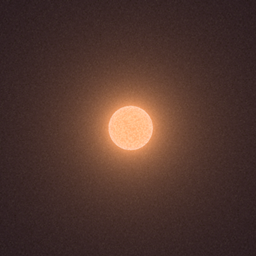
The Sun at the world centre. A shader-rendered star sphere sits at (0,0,0) with a seed-derived radius of 50,000–100,000 blocks (rendered and server-authoritative from the same formula, synced to clients). Flying into its outer 10% shell inflicts escalating heat damage; touching the surface kills. Players who log in or respawn inside the sun are dropped straight into an initial orbit instead of the void.
6DOF quaternion flight. Movement is driven by quaternions instead of Euler angles, so pitch, yaw and roll are
fully free — no ±90° clamp, no gimbal lock. Q/E roll left/right, view smoothing keeps the crosshair aligned
with the physics direction, and top speed is 10 blocks/tick (200 m/s). Rotated OBB hitboxes follow your body
rotation (F3+B to view).
Acceleration damage. Hard impacts (a sudden single-tick velocity drop) and sustained high-G overloads (30 G instant / 10 G sustained windows) hurt, and vanilla fall damage is disabled in flight mode. Detection is client-measured, server-authoritative, so singleplayer and multiplayer behave identically.
Orbital mechanics for players and mobs. A Newtonian inverse-square gravity field centred on the sun, integrated
numerically every tick (velocity Verlet) for the player and for every other entity. mu defaults to 6.25e6
blocks³/tick², i.e. a circular speed of 2.5 blocks/tick (50 m/s) at the inner belt's 1,000,000-block radius,
1.12 blocks/tick at 5,000,000 blocks and 11.2 blocks/tick (224 m/s) at the sun's surface — tune it under
Orbital Mechanics in the config. Player motion is server-authoritative: the server integrates from the input
mask the client reports, ignores the client's position packets and streams the authoritative state back; the client
predicts locally with the same integrator and reconciles against the server by input sequence number (rewind and
replay only when the prediction drifts past orbitalCorrectionBlocks). Two vanilla behaviours had to be neutralised
for this to work at all: ServerGamePacketListenerImpl.tick rolls the server-side player back to its pre-tick
position right after player.doTick (the authoritative position is re-asserted at the end of the connection tick),
and LivingEntity.aiStep zeroes velocity components below 0.003 blocks/tick (both sides therefore keep their own
authoritative velocity instead of reading deltaMovement). While offline the player is not ticked: the osculating
Kepler elements are stored with the logout tick and propagated analytically (elliptic and hyperbolic) on the next
login, so the orbit keeps running without them. The first time a player enters a world they are assigned a random
initial orbit inside the configured band (orbitalSpawnRadiusMin–orbitalSpawnRadiusMax, default 1.0M–1.5M
blocks, i.e. the inner asteroid belt) with a bounded inclination so the whole orbit stays inside the same thin disc
as the belts (orbitalSpawnMaxAbsY, default 8000 blocks) and a small eccentricity (orbitalSpawnMaxEccentricity,
default 0.15); death respawns get a fresh orbit too (orbitalSpawnOnRespawn). The old 5–10M block "spawn ring" is
gone — the world spawn point itself is corrected into the orbital band on load.
/orbit info reports the current state and
/orbit circular <radius> [inclinationDeg] drops you into a circular orbit (inclination measured from the
equatorial XZ plane: 0 = equatorial, 90 = polar); F3 shows radius, speed, orbital elements and the
prediction-correction counter.
Procedural asteroid belts. A datapack-driven, fully procedural asteroid system: zero storage, zero files.
Each asteroid has an index identity and a deterministic Kepler orbit derived from a seed (/asteroid info <index>),
grouped into belts defined by asteroid_belt / asteroid_type JSON with weighted types and structure variants.
A per-tick proximity service keeps nearby asteroids loaded (index preload + strong-load radius), and /asteroid
exposes meta, belts, info, near, loader and reload.
Materials from space. 20 ore sands and 19 ingots (13 metals + 6 alloys such as Incoloy 890, tungsten–rhenium and GH4061), extracted from asteroid ore blocks and smelted up the chain. Ore blocks are registered and datagen-complete; world generation and the survival smelting chain are still work in progress.
Lighting and rendering. Optional full-brightness mode skips the light engine entirely for a large tick/frame saving, and a built-in Iris shader pack renders the sun as a radial light source with real shadows cast from it (deployed automatically on first launch; Iris is a soft dependency).
Sable / Create Aeronautics integration. The Sable plotyard (sub-level block storage) is relocated inside the sun so physics coordinates stay in a low-magnitude range (f32 ULP ~4 mm instead of ~2 blocks), and Rapier scene coordinates are float-rebased with a per-scene origin so sub-level physics stays precise out to millions of blocks.
Commands
| Command | Purpose |
|---|---|
/asteroid meta | System overview: belts, types, totals, seed, μ, datapack state |
/asteroid belts | Belt list: radii, inclination, counts, type weights |
/asteroid info <index> | Orbit elements and world position of one asteroid |
/asteroid near <radius> | All asteroids within a radius of the player |
/asteroid loader | Proximity loader status |
/asteroid reload | Reload the asteroid datapack |
/orbit info | Your orbital state: mu, radius, speed, elements, period, apsides |
/orbit circular <radius> [inclinationDeg] | Enter a circular orbit (0° = equatorial, 90° = polar) |
/orbit mu | Current gravitational parameter |
Requirements
- NeoForge 21.1.234 for Minecraft 1.21.1
- Sable / Create Aeronautics
- Iris + Sodium (optional: built-in shader pack)
Status
0.3.1-beta — physics, orbital mechanics, sun, lighting and the asteroid system are playable. The survival
material chain (world-generated ores and smelting recipes) is not finished yet; materials are currently
creative-only.
AI
Contains AI-generated content